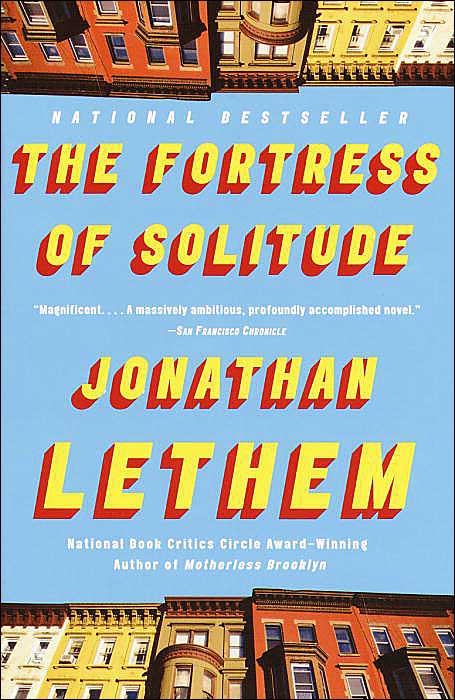
The Fortress of Solitude
By Jonathan Lethem
I found this book when the History Graduate Student Association had a book sale on the stairs of the building in which I had a British Lit class. Paperbacks were a buck apiece, which is, for me, a lot like setting up a discount crack house next door. I had read some reviews of this book and had seen some of his other titles in book stores and I figured it was worth the book. Plus I'm an addict, and until I check myself into some 12-step program, I'm going to keep buying more books than I can read.
In one of the reviews in the first few pages of the book, a critic says that Lethem loves words. This didn't seem right to me, I think it's closer to the truth to say he loves phrases. He'll repeat in the narration without prompting small sentences of pop-culture or personal meaning. He has characters do the same and the feeling constructed is similar to being in the middle of a crowd. The reader can pick up just fragments of what the entire city is saying.
Solitude tracks the life of Dylan Ebdus from his moving to Brooklyn as a small child into his late 30's. I can't decide if the book is about his whole life with the appropriate reverence given to his pre-teen and teenage years, or if it's about a white kid growing up without a mother in an all-black neighborhood that goes on too long into his adulthood.
Lethem creates a character in Dylan that is not only believable, but someone you want to succeed. I found myself scared to turn the page fearing something bad would happen to the protagonist.
The author's foray into magical realism (Dylan finds himself in possession that can make people fly and later makes him invisible) feels like a heavy-handed metaphor more than something he was really devoted to exploring. For someone that has such a great grip on realism, I'm not sure why he felt the need to stretch the boundaries in this work. The way he nails certain teen experiences, it's clear Lethem hasn't forgotten his own adolescence. He gets everything exactly right, from how it feels not to be in your friend's band to sitting stoned in your friend's basement scratching the bottom of a box of Nilla Wafers for crumbs.
The last 75 or so pages are devoted to Dylan's friend Mingus Rude who is the best character in the novel. Mingus is Dylan's best and only black friend. Their lives run parallel enough to notice but not so close that it's a central theme of the book. This is perhaps the strongest statement about race-relations in the book, the difference between the two kids with similar situations and how they turn out, one white, one black.
The book does go on a little too long and a little too far into Dylan's adult life. While his childhood still haunts him, I just didn't think it was necessary to extend the book that far to make that point. I can't blame the author though, once Lethem decides that he's writing about Dylan's whole life, it must be hard to stop.


No comments:
Post a Comment