Wednesday, September 17, 2008

Rabbit at Rest


Rabbit at Rest
By John Updike


John Updike's magnum opus series - Rabbit Angstrom - is one of those works that should be read in high schools but isn't for a lot of different reasons. Updike doesn't have the tragedy of a Hemingway or the shyness of a Salinger. He's undoubtedly a modern canonical author, but his work doesn't fit in the current trend in the literary world. With the opening of the canon, most modern authors that have been added - at least to school book lists -are from underrepresented minority groups. Not that these books aren't worthy, but it leaves out excellent authors like Updike. I'd be willing to trade some Shakespeare in for the more relevant Updike.

Rabbit at Rest is the final volume of the four-book series. The novels follow former-high-school basketball star Rabbit Angstrom as he moves through the 50's , 60's, 70's and 80's, each book taking one decade. Rabbit is a sort of everyman, a product of his times. With the shift of American society, Rabbit shifts too.

Rabbit at Rest takes place in the 80's, with the end of Reagan administration and Bush Senior taking office. Rabbit finally starts feeling like a relic. He's in his 50's and having serious heart problems. His illness and decline is paired with what he sees as the same decline of America. AIDS and the drug war are in the news, and he fears in his own family. His son Nelson is now an adult (sorta) and has taken over Springer Motors - Rabbit's wife's inherited car lot. Rabbit at Rest is largely about Rabbit and Nelson's relationship. All the trauma Rabbit has visited upon his son comes to the forefront as Nelson struggles with drug addiction while trying to raise a family and run a business - none of which he does very well.

Concluding a series like Updike's must be a difficult job. Philip Roth's Exit Ghost (also reviewed on this blog) did the same thing, and I think did it better. Updike's ending is clean, whereas Roth's is frayed. Rabbit's heart problems are neater and easier to deal with that Nathan Zuckerman's prostate cancer. Updike gives a sanitized version of decay, his protagonist doesn't suffer from impotence like Roth's, but instead deals with his continuing libido - and not very well.

Although the final installment of the Rabbit series is my least favorite of the four, it gives the reader a depiction of the 80's in suburban America, instead of the high-flying Wall Street version that's usually portrayed. It's a strong and solid novel that ends one of the better modern narratives, something people who lived it will remember, and those of us who didn't can imagine.

Sunday, September 7, 2008

Fathers and Sons


Fathers and Sons
By Ivan Turgenev

According to his Wikipedia entry, Nabokov thought Turgenev was the 4th-best Russian author (above Dostoevsky) and he has the the largest recorded brain-weight. For these reasons alone I wanted to read his best-regarded novel.

Fathers and Sons is about two sets of pre-revolutionary Russian fathers and sons and their ideas about life and society. The new generation's philosophical nihilism is pitted against their fathers' traditional (albeit modernizing) beliefs.

I was surprised how much the character depictions and conflicts remain relevant to this day. It's definitely a good read for radical sons and liberal fathers. It teaches us that our kitchen-table arguments aren't that original. (Dad, I swear I just call you a fascist sometimes because it pisses you off).

The novel also deals with reconciling philosophical dogmas with the reality of human feelings and desires. Can a doctrine like nihilism overthrow the desire for family and love?

The depictions of college-age radicals is right on. They're not portrayed as petulant or dumb, but still in the process of solidifying their beliefs. The adults aren't condescending but are legitimately afraid of the generational shift. The parents also aren't aristocratic autocrats, but rather good-hearted men trying to keep up with changing times. Their interactions have a very realistic nuance.

Tom Stoppard seems to have stolen a lot of Turgenev's ideas in his Coast of Utopia play trilogy. Yet he lacks Turgenev's sympathy for the young men. Stoppard sees them as arbitrary and immature while Turgenev sees that they're bright and forward-looking, if not fully clear on their complete philosophies. The conflict and writing are both engaging and it's a quick read. I generally trust a guy smart enough to write Lolita in his third language, and he didn't let me down.

Saturday, August 30, 2008

This Boy's Life


This Boy's Life
By Tobias Wolff

Writing a memoir that doesn't stink of trite self-obsession is a tough job these days. Wolff wrote This Boy's Life well before the current crop of made-up personal histories brought shame on the whole genre, and it seems like those fabricators might have read his book for inspiration.
More than anything, This Boy's Life is about the central role lying played in young Mr. Wolff's life. the story is of his childhood, from elementary through high school with his single mother. It has the elements that seem perfunctory in such a story, the crazy abusive step-father and the distant admired father. Thankfully Wolff portrays these people from his memories as just that instead of crude caricatures. He's too good a writer for anything less.
Wolff shows how lying becomes a lifesaver for him in his tumultuous childhood. He has some of the regular childhood experiences with fibbing, but when his trusting mother lets him get away with it, the lies don't contract but expand. It's easy to see the progression from sneaking cigarettes and graffiti to attempted check fraud and boarding school application-doctoring.
The virtuosity of the writing comes though in the lack of emotional blackmail that would have been simple with such a moving story. Wolff doesn't demand the reader's sympathy, but instead tells what happened and how it felt without an apparent an agenda. It's more a work of literature than a confessional sob-story, much like Dave Eggers's Staggering Work of Heartbreaking Genius.
I'm not sure why true stories tend to sell a lot better than novels about the same topics, it leads to people who have gone through a lot of shit writing about themselves and breaking into the literary world. But Wolff is not this, he is a novelist who tackled the story of his own history.
Just looking for the image for this review I found out there was a movie made in 1993 with Leonardo DiCaprio. Judging from the poster, it's everything I was thankful the book wasn't. That's probably why I never heard of it.

Weight


Weight
By Jeanette Winterson

I have to give my mom her due credit. Throughout my life she has suggested authors I'd like (Gide, Calvino, O'Toole and many more) and I usually ignore her at my own peril before eventually reading them and regretting not doing it years ago. Jeneatte Winterson is one of these authors. It wasn't until my narrative theory professor made me read one of her short stories (the most graphic depiction of lesbian sex I've read for class since grade school) that I finally understood why my mom had been badgering me. Winterson grasps post-modernism in a way no other author I've read does, she swims in it like a fish while other authors doggie-paddle to stay above the water line.
Weight is a re-telling of the myth of Atlas and Heracles with Winterton's signature firm touch. Heracles is basically the frat-boy we would be instead of the Disney hero. It feels like Winterson understands and embraces the brutal sensuality of the Greek myths that we seek to sanitize.
Atlas is long-struggling Christ figure, but his fight is more with himself than with socialism, sorry Ayn Rand.
To just tell the story wouldn't be good enough for Winterson. She integrates autobiographical elements and a Soviet astro-dog to add facets of the Atlas story not normally discussed. She manages to make the break between the (semi)mimetic and non-mimetic cleanly enough not to bother me. It doesn't feel like an exercise, but rather a confession.
Using a familiar myth that already has so much attached to discuss what our pasts mean to our futures is a tough burden, but Winterson shrugs it off with her overwhelming ability. The book is about 150 pages, read it in one sitting, it'll take you about an hour and a half.

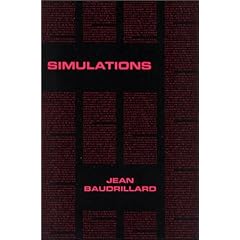
Simulations


Simulations
By Jean Baudrillard

Woah.

Thursday, August 28, 2008

Journey to Ixtlan


Journey to Ixtlan
By Carlos Castaneda

In the first two semesters of my time at Maryland I was looking to understand myself further. With my recent rediscovery of the wonders of words and literature, only three years preceding, I knew reading would be a significant factor in my introspective endeavors. At the same time, I was well in tune with my affinity for personal and direct experience and exploration. I found a meditation group where I was given a book list. Journey to Ixtlan was on that list. The story in Journey to Ixtlan was parallel to my own "spiritual" yet existential investigations.
Carlos Castaneda, an anthropologist, journeys to deep parts of a desert to visit Indian sorcerer Don Juan and discovers a lot from what he is not told. He goes with an objective taxonomic mindset: he just wanted answers to his questions about Indian demographics. In retrospect, he finds that his aim was a) existentially arbitrary and b) the Indian population was so mixed and multicultural that it would be quite difficult to get any straight answers. However, something kept him coming back though he was not making any headway on his assignment. The mystery of Don Juan’s ways in warriorhood brought him back season after season. In the end Carlos found a new outlook on life, not exactly in a new-age way, but that the fabric of his existence acquired a higher thread-count.
Oh yeah—I was very disappointed that no explicit accounts of peyote trips were recorded. But there was some trippy stuff in there.
I wondered why a book that explores Native American spirituality was on that book list. And I found my answer; Castaneda became fully aware of the robotic manners of his intellectual, academic, life pursuits. All the while, he thought he had some control and choice but in truth, he was totally limited to identifying with his “roles” and memories. To put it in a few words, I think Carlos’s Journey to Ixtlan points out how social and societal education entwines with self-identity to become a cognitive drug for the masses. It is possible to function without drugs or intoxication and still be part of a drug-culture: to be a warrior.
"Only as a warrior can one withstand the path of knowledge...because the art of a warrior is to balance the terror of being a man with the wonder of being a man."
~Journey To Ixtlan

Sunday, August 3, 2008

Equus


Equus
By Peter Shaffer

When people would ask what I was reading and I told them Equus, the most prevalent response was, "Oh yeah! That's the one that Harry Potter was naked in!" Yes, this was the play Daniel Radcliffe was in, and yes the part required him to be naked. I don't really care. What's more important to me is that this play was fantastic.
The story focuses on a boy Alan and his psychologist Dysart. The play starts with Alan having had blinded 6 horses with spikes at the stable at which he works. Dysart probes the inner-workings of Alan's mind deftly.
Equus is more than anything a statement on the effects of the modern condition on the minds of its subjects. Alan is stuck between the conservative Christianity of his mother and his father's scientific intellectualism. The strain drives Alan into insanity and into the deification of horses that 5th grade girls could only dream of.
The way the play is staged is inventive and brilliant. All the actors stay on stage throughout the play. Flashbacks are done in the middle of scenes, with actors rising from their places on a bench (still onstage) to talk to the characters in the middle of the action. It's not hard to imagine what's going on and so this technique adds a sort of fluidity that is as beneficial to a reading as I'd imagine it would be to a viewing.
The mastery of the play is Dysart and Alan's sessions. Alan is obviously as intelligent as he is disturbed. Dysart is a very capable psychologist who doesn't fall prey to Alan's hysterics. Dysart has his own basket of psychological issues that are not all that different from Alan's, but Dysart recognizes them clearly but sees no escape. Except, that is, for the insanity that Alan has adopted.
Sexuality in the modern world is a main theme of the play. How is a young man supposed to reconcile newly-loosened sexual mores with traditional and irrational restrictions? Blinding horses seems to be the only way (okay, it's a bit more nuanced than that, but still).
The play doesn't offer any easy answers, only complex critiques, which is a relief. Shaffer asks us to examine the contradictions both in ourselves and our modern society.