Saturday, June 21, 2008

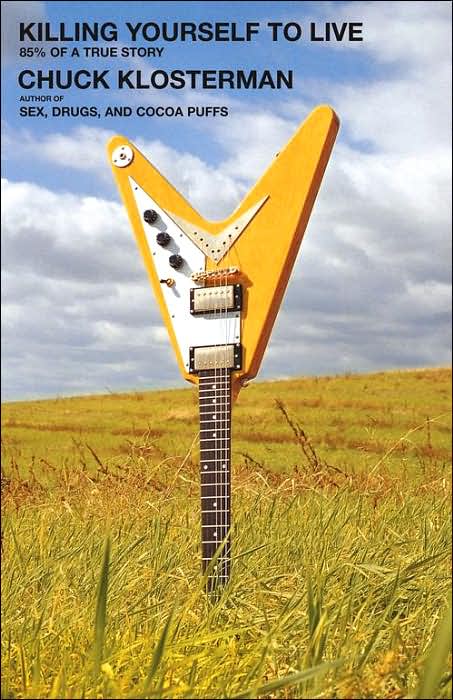
Killing Yourself to Live


Killing Yourself to Live
By Chuck Klosterman

I am deathly afraid of being or becoming Chuck Klosterman. Normally people don't express fear at the idea of being a best-selling author who writes for pretty cool magazines, but the fear remains. I bought hard-cover copies of both Killing Yourself to Live and IV for five bucks apiece on sale at the campus bookstore, having heard Sex, Drugs and Cocoa Puffs was good. My problem with Chuck Klosterman isn't that his writing is bad (although sometimes it is), it's that he only writes about one thing, and that one thing is Chuck Klosterman.
Killing Yourself to Live is ostensibly about Klosterman's cross-country trip to visit death scenes of rock musicians. This is not what the book is about. The book is about three women Klosterman has slept with. His ability to make anything about the minutiae of his own life verges on masterful. I'm convinced he could interview Robert Mugabe and the piece would end up being about some girl he almost kissed in the seventh grade.
For whatever reason, Klosterman think self-awareness is an excuse for narcissism. It's not.
What kills me is that his writing (with a few notable exceptions) is not bad. It's cute and gimmicky and self-conscious, but it's actually pretty good. Killing Yourself is an engaging and really quick read, I just can't figure out why. It should be terrible, but it's not.
He references obscure pop-culture figures incessantly, which I think he knows doesn't make him cool. I think he thinks it makes him uncool, which he thinks makes him cool. I'm not sure which is worse.
Also, he doesn't like Robert Johnson. What's up with that?
Although he generally gives off the air of a middle-schooler who read Fear and Loathing in Las Vegas and decided he was going to be Hunter S. Thompson, Klosterman is incredibly readable. The idea that Klosterman could be this generation's Thompson scares the shit out of me but also makes a lot of sense. He's so painfully self-aware and introspective that it feels normal when he starts analyzing his own self-analysis. Gone is the reckless destruction of Thompson, now we have Klosterman doing cocaine so he can write about that time he did cocaine.
I want to hate Killing Yourself to Live so badly, but I just can't. Don't read it. Read something better. But if I see people reading Klosterman on the metro, I won't want to bludgeon them to death.
That's something.

Tuesday, June 17, 2008

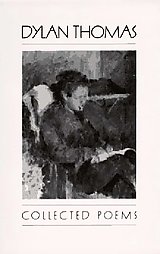
Collected Poems of Dylan Thomas


Collected Poems
By Dylan Thomas


I recently starting commuting every morning to my summer job in D.C. and I've been trying very hard not to read this on the metro. It isn't that the work isn't incredible (it is) just that I don't want to be the one prick in the ocean of riders locked on Janet Evanovich and The Secret reading Dylan fucking Thomas.
At a certain point I just gave up. I've never read the fully collected work of a poet before and it's definitely an experience I'd recommend. His transition in style is palpable. Thomas's poems get progressively longer and more concerned with structure. Personally I prefer the earlier stuff (see, those are the kind of things that make me feel like an asshole) but there's great content all through.
About every third poem hit me hard. I found myself calling friends in the middle of the night telling them they needed to go online and read "The hand that signed the paper" because I needed to talk to someone else about it. For someone I certainly would not classify as a love poet, Thomas writes about love more convincingly than the so-called romantics. When he writes "Daft with the drug that's smoking in a girl/and curls round the bud that forks her eyes" I shudder.
Another interesting thing about reading a collection like this one is that it's easy to see patterns in word-use and subject. He has a big thing for the word "marrowed" and for animal imagery. But not obnoxious animal imagery.
It's not hard to see how Thomas influenced later generations of poets. He writes about love, politics and society as someone removed yet immersed in all of them. But most importantly, he writes about death. In fact all of his poems are about death. The last one in my copy, "Elegy" I've already decided I want read at my funeral. Thankfully I won't be around to see my mourners complain about what a pretentious dick I was to have that read at my funeral.

Monday, June 16, 2008

The Brief Wondrous Life of Oscar Wao


The Brief Wondrous Life of Oscar Wao
By Junot Diaz


I read Junot Diaz's short story collection Drown last Winter Break when my now-roommate was going to sell it back to the school after reading it for a creative writing class. I convinced him to give it to me for my birthday (which it was) instead.
I'm a sucker for a good short story collection and Drown is excellent. I imagine it's what Raymond Carver would have written were be born Dominican in New York in the 70s. Diaz's writing is nerdy with a badass sensibility, or maybe it's the other way around. Either way, it's fucking good.
Oscar Wao took 10 years to write and it shows. The book is amazingly intricate for it's length (327 pages). It's about a nerdy Dominican teenager (Oscar) living in Jersey. But it's also about the Dominican dictator Trujillo and living under totalitarianism. But it's also about Oscar's entire complicated family history (very Marquez-esque). It's about a lot of things, but still doesn't doesn't feel overloaded or too dense.
The narrator is Diaz's alter-ego Yunior who also pops up in Drown and other short stories he's published. Yunior has a distinct sympathy for the title character, but is far enough removed to disdain him the same way most readers would a teenager 150 pounds overweight who plays Dungeons and Dragons and has never kissed a girl. The result is one of the more effective uses of narration I've read in a long time.
Oscar Wao is also the first book I've read that has footnotes containing the word 'fuck'. These footnotes contain a lot of Dominican history, but with Yunior providing such good narration they are some of the best parts of the novel.
To read the book it might help to speak Spanish and be a recovering fantasy-geek. The Spanish wasn't oppressive, I didn't feel like I missed that much with my high-school French. As for fantasy geek, having read The Lord of the Rings is sort of crucial, but the movies should work for anyone who had better things to do in elementary school.
Diaz has gotten a lot of praise from both mainstream audiences (hitting the bestseller lists) and literary circles (Pulitzer and National Book Award) and he has to feel vindicated after his decade of work. That said, I hope the next one doesn't take as long.

Sunday, June 15, 2008

The few, the proud

This blog exists for the express purpose of providing a forum for people (okay, my friends) to do mini opinion reviews of books they read. According to an article I found (http://www.boston.com/news/nation/articles/2004/07/09/survey_finds_drop_in_reading_rates/) 42.8 percent of 18-34 year-olds read a book in the last year. This blog is not designed to solve this problem. This blog does not bemoan the state of our culture. This blog is not written by Harold Bloom. I just needed a name. So when you read a book, write a few paragraphs about it. We won't save the culture or reading, but we will get good ideas for books to read. Because as members of the 42.8 percent, that's what we do.